
Past Events

Will Atlantic Yards' Third Time
Be the Charm or a Strikeout?
Wednesday October 14, 2026
Replay
Coming Soon!
Atlantic Yards has already swung and missed twice. In 2006, Forest City Ratner won approval for the project, built the arena, then stumbled with modular construction, and needed a partner with capital to continue. In 2014, Shanghai-based Greenland USA stepped up to the plate, promising to finish the job. But its plans ran aground with the collapse of the Chinese real estate market. The scoreboard: only 40 of a promised 900 apartments for tenants earning less than 60% of area median income have been built, and the blight-inducing rail yards the project supposed to cover remain exposed twenty years later.
Now, after years of delay, a third team, led by Cirrus Real Estate Partners and LCOR, has emerged with a new vision: Thousands more apartments, towers as tall as 80 stories, and a level of density unprecedented in New York City. For this, the State is offering $700 million in new direct subsidies for platforms and additional PILOT financing to come. What extra value is the public getting for this new round of concessions? And will the State finally ensure that the development team delivers, or will it stand by yet again as the project strikes out?
Our panel of experts have been engaged with the project for years and will discuss what goals have been met, what’s been learned so far from failures to meet outstanding commitments, the merits of the proposed Phase II plan, and where we should go from here.
Gib Veconi
Gib is Chair of the Prospect Heights Neighborhood Development Council
and is a board member of the Atlantic Yards Community Development Corporation, a State agency charged with overseeing the project’s public commitments. He led Brooklyn Community Board 8’s M-CROWN rezoning, approved by the City Council in 2025 as the Atlantic Avenue Mixed Use Plan.
Norman Oder
Moderator
Norman, a journalist for more than 40 years, writes the watchdog Atlantic Yards/Pacific Park Report, with news, analysis, and commentary. He has broken significant stories about affordable housing, EB-5 financing, and modular construction, among many issues, and contributed to the New York Times, Newsday, City Limits, and other publications.
Jo Anne Simon
Jo Anne is a member of the New York State Assembly for the 52nd District, which overlaps the Atlantic Yards iproject. She is one of the founders of the BrooklynSpeaks coalitions, which has been advocating for accountability at Atlantic Yards since 2006.
Ismene Speliotis
Executive Director of the Mutual Housing Association of New York (MHANY), where her work has focused on very low-income neighborhoods and on meeting the needs of low- and moderate-income families. Under her leadership, MHANY has increased its portfolio to over 1,500 apartments in Brooklyn, the Bronx, Manhattan, and Queens. In 2005, she negotiated a community benefit agreement for affordable housing at Atlantic Yards.
John Shapiro
John is a professor at Pratt's Graduate Center for Planning and the Environment, a former Chair of the program. Prior to this, he spent 25 years as a principal at Phillips Price Shapiro Associates, one of the region’s leading planning consultancies. He co-chairs the Waterfront Committee of City Club of New York


Evaluating the City's Housing Framework: What does growth have to do with fair housing?
In 2023, the City Council adopted the Fair Housing Framework (Local Law 167), which requires New York City to produce a plan for the distribution of housing construction, using equity as its guiding principle. The result, the City's Fair Housing Growth Strategy, calls for the addition of 700,000 housing units over ten years, tripling the recent rate of construction and adding the equivalent of Philadelphia within the existing city limits. About three-quarters of the new units would be market rate, and much of the "affordable" portion would be unaffordable to most New Yorkers. The plan's underlying assumption is that increasing the city's overall housing supply will eventually make housing affordable to those most in need. But what is the evidence that a plan built on that premise will advance the goal of fair housing?

In this program, we will be joined by Chris Walters of the Association for Neighborhood and Housing Development (ANHD), Andrew Berman, Executive Director of Village Preservation, and planner and housing scholar Alan Mallach. ANHD argues that the plan has skipped the consideration of affordable housing needs that the law requires, and that it has set district production targets based exclusively on recent production levels rather than on proper analysis. Berman will discuss what the targets would mean on the ground, and why Village Preservation questions the premise that NYC is facing a general housing shortage. rather than a shortage of affordable housing. Mallach will draw from decades of experience with New Jersey's Mount Laurel fair share housing system in evaluating the City's current approach.
Does this plan actually address equity concerns? If not, what would a better considered fair housing strategy look like? Join our event and be part of the discussion!
Alan Mallach
Author & researcher, Sr. Fellow, CCP; former Director of Housing & Economic Development (Trenton, NJ)
Andrew Berman
Executive Director, Village Preservation
Layla Law-Gisiko
Moderator
President, City Club of New York
Chris Walters
Associated Director for Policy & Research, ANHD


Can New York's Streets Be Fast, Safe, and Quiet?
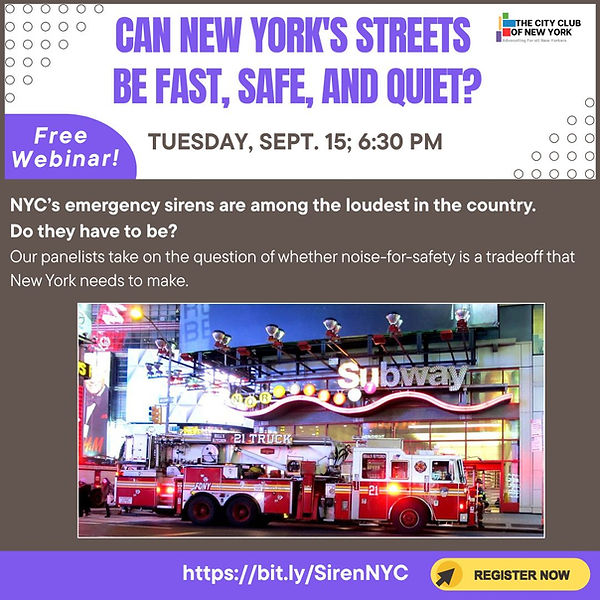
September 15, 2026
New York's emergency sirens are among the loudest in the country. Ambulances and fire trucks routinely exceed the decibel levels of a jet at takeoff. These volumes take a measurable toll on the cardiovascular health, hearing, and mental well-being of both residents and responders. The justification for sirens has always been safety. Sirens move traffic out of the way so responders can arrive more quickly. But is noise a safety necessity or a workaround for streets that were never designed with emergency response in mind? And more basically, does the difference in speed lead to better clinical outcomes?
This panel takes up the question of whether noise-for-safety is a tradeoff New York still needs to make.
The conversation will cover: the public health case against high-decibel sirens; the recent push for lower-decibel alternatives; lessons learned from the experience of other cities; and street-level fixes that might reduce the frictions that justifies siren noise in the first place. Join us as we grapple with the question of whether reducing the siren noise harm means accepting worse emergency outcomes, or whether we can have quiet without compromising safety?
Jeffrey Malamy
Director of Street Improvement Projects at NYC DOT and leads the strategic planning and execution of major street infrastructure enhancements.
Juan Rivero
Moderator
Special Projects Director at Village Preservation and Chair of the Programs Committee of the City Club of New York
Gale Brewer
Council Member of NYC District 6, a former Manhattan Borough President, and the sponsor of a bill on emergency vehicle signaling devices
Jamie Banks
Founder and President of Quiet Communities. She is a health care and environmental scientist with an extensive background in health outcomes and economics, behavior change, and policy.


What Does Design Have To
Do With Planning?
Co-sponsored by:
Congress for New Urbanism & Village Preservation
New York City builds a lot, but does it build well? And who, if anyone, is responsible for ensuring that it does?

This panel brings together planners and urban designers to explore the relationship between design and planning in New York City at a moment when that relationship is under strain.
The recent disbanding of the Department of City Planning's Urban Design Unit (with little explanation and no public debate) raises concerns about whether the City has abandoned its commitment to shaping the built environment beyond the blunt instruments of use and density regulation. At the same time, the Public Design Commission, which reviews city-funded projects for design quality, has largely operated at the tail end of the development process, prompting the question of whether more proactive design input might produce better outcomes for New Yorkers.
More broadly, the panel will grapple with a tension running through contemporary planning debates: does insisting on design quality serve the public interest, or does it add unnecessary cost and friction to an already costly development process?




David Burney
Moderator
Co-founder & Director of the Urban Placemaking & Management program at Pratt Institute (Architecture) and Chair of the Comprehensive Planning Committee of the City Club of New York.
Laurie Hawkinson
Architect member of the New York City Public Design Commission and a partner at Smith-Miller + Hawkinson Architects.
Jack Travis
Architect, educator, interior designer, and cultural design consultant based in the South Bronx.
Matthew Lister
Managing Director for Gehl US and focuses on the intersection of real estate strategy and the design and activation of great public spaces.
Cracks in the YIMBY Consensus –
Part I: Why can’t we upzone our way out of the affordability crisis?

Tuesday, May 12, 2026
This event is part one in the ongoing program series: Cracks in the YIMBY Consensus.
This series is co-sponsored by Village Preservation.
New York City’s and the nation’s affordability crisis has revived a powerful idea: if we build more housing, prices will fall. This has led to a widespread diagnosis: the reason we’re not building enough is because our housing market has too many rules! Over-regulation, especially zoning, is holding back construction and driving up prices — or so the theory goes.
It’s a clean, simple story. And it has attracted strange bedfellows, from free-marketers to developers to housing advocates. But does the evidence support it?
This series brings together housing experts to examine research, including their own, that challenges this popular narrative.
In Part 1 of Cracks in the YIMBY Consensus, we speak with planner and housing researcher Alan Mallach and disentangle the knotty relationship between housing prices, household incomes, and development costs in New York and elsewhere. We discuss who is most affected by the affordability crisis (maybe not who you think), why it is different depending on where in the U.S. you live, and why zoning is mostly a red herring when it comes to understanding the causes of the affordability crisis.
Moderators:
Juan Rivero, Special Projects Director, Village Preservation
Andrew Berman, Executive Director, Village Preservation
Alan Mallach is the author of The Divided City: Poverty and Prosperity in Urban America and A Decent Home: Planning, Building and Preserving Affordable Housing. A senior fellow with the Center for Community Progress in Washington DC, he was director of housing and economic development in Trenton, New Jersey, has worked at the Brookings Institution and the Federal Reserve Bank of Philadelphia, and taught at Rutgers University and the Pratt Institute.

Part II: The Zoning Scapegoat – Does Regulation Actually Explain the Housing Crisis?
June 23, 2026
This series is co-sponsored by the City Club of New York and Village Preservation and CNU NYC
San Francisco and Houston are the twin poles of the American housing debate. San Francisco: high regulation, scarce housing, sky-high prices. Houston: permissive zoning, abundant construction, relative affordability. The lesson seems obvious: deregulate and build your way to affordability. But does the evidence actually support this characterization and that lesson?
In Part 2 of Cracks in the YIMBY Consensus, we speak with Federal Reserve economist John Mondragon, whose recent research challenges the premise underlying this popular contrast. Examining decades of housing data across hundreds of U.S. cities, Mondragon and his co-authors find that measured supply constraints, such as zoning regulations, do not explain differences in the growth of housing prices or quantities across metro areas. The reason for the divergence between San Francisco and Houston, they argue, is found in the composition of economic growth, and not in the relative permissiveness of each city’s zoning code.
We will discuss what this finding means for our understanding of the affordability crisis, compare the actual national housing picture to the predominant representation of it, and consider what it would mean to treat demand, rather than supply, as the starting point for affordable housing policy.

Moderators:
Juan Rivero, Special Projects Director, Village Preservation
Andrew Berman, Executive Director, Village Preservation
Presenter:
John Mondragon is a research advisor at the Federal Reserve Bank of San Francisco, where he works on the mortgage and housing markets and empirical macroeconomics. He is the co-author of “Supply Constraints do not Explain House Price and Quantity Growth across U.S. Cities” (February 2026) with Schuyler Louie and Johannes Wieland.
Part III- Reframing the Affordability Debate: Housing as the Foundation of Community
Wednesday, July 22, 2026
This event is part three in the ongoing program series: Cracks in the YIMBY Consensus. This series is co-sponsored by Village Preservation and CNU NYC.
Our first two programs in this series examined the standard story that blames unaffordability on regulation and supply shortages, and we found some real cracks. This finding should have serious implications for how we approach affordable housing. But any policy reorientation should start with a more basic question: what should housing policy actually be trying to achieve?
In Part 3 of Cracks in the YIMBY Consensus, we turn to this fundamental question with long-standing planner and activist Ron Shiffman, who argues that housing policy should primarily be judged by whether it builds strong, stable, and democratically governed communities, and not by whether it meets production targets. The guiding policy questions should be: Does it protect long-term affordability and prevent displacement? Does it make neighborhoods and the city more livable? And is someone accountable if it fails to achieve those goals or undermines them?
Join us as we discuss the ramifications of measuring housing success differently, not just by how much gets built, but by who can stay, by who gets a voice in planning, and by whether development strengthens or erodes its surrounding communities.
Moderators:
Juan Rivero, Special Projects Director, Village Preservation Andrew Berman, Executive Director, Village Preservation
Presenter:
Ron Shiffman Professor Emeritus at Pratt Institute School of Architecture and a planner with over fifty years of experience in providing architectural, planning, community economic development and sustainable development assistance to community-based groups in low- and moderate-income neighborhoods. He was appointed to the NYC Planning Commission by Mayor David Dinkins and served there from 1990 to 1996. Currently, he is a board member of the Atlantic Yards Community Development Corporation.

Part IV: The Zoning Alibi
September 23, 2026
This event is part four in the ongoing program series: Cracks in the YIMBY Consensus. This series is co-sponsored by Village Preservation and CNU NYC.
The YIMBY account of America’s affordability crisis has become conventional wisdom: restrictive zoning is choking off the housing supply and preventing new construction from bringing prices down. This story has been amplified by journalists and real estate interests, gained political traction on both sides of the aisle, and become the justification for treating deregulation as an affordable housing strategy. But does the evidence support the YIMBY narrative?
In Part 4 of Cracks in the YIMBY Consensus, we speak with economic geographers Maximilian Buchholz (UC Berkeley) and Tom Kemeny (University of Toronto) about research done with Gregory Randolph (Georgia Tech) and Michael Storper (UCLA/LSE) that calls into question both the relation between zoning restrictions and rising housing prices, and the efficacy of deregulation in lowering them. Their paper “Inequality, not regulation drives America’s housing affordability crisis” received coverage in the mainstream media, marking a salient departure from the usual regurgitation of supply-side talking points. The panelists will make the case that no realistic construction boom would provide significant relief to cost-burdened households in major U.S. cities, and they argue that income inequality offers a far better explanation than regulation for rising housing prices. The discussion will then consider the policy implications of their findings and of understanding the affordability crisis not as a problem of supply but as one of demand.
Juan Rivero
Moderator
Special Projects Director at Village Preservation and Chair of the Programs Committee of the City Club of New York
Tom Kemeny
Professor at the Munk School at the University of Toronto. His research is focused on cities and determinants of economic performance. Current projects include an investigation of the changing geography of wealth in the United States.
Max Buchholz
Assistant Professor in the Department of City & Regional Planning at UC Berkeley. His work focuses on the drivers of disparities in economic opportunity across and within U.S. cities.



Reclaiming the Streets:
Promise, Pushback, and Path Forward
Wednesday, May 6, 2026
New York City’s Open Streets program, born during the pandemic, turned car lanes into public space for walking, dining, and community life. Now permanent, the program spans hundreds of locally run sites across the city. But the program’s future is far from settled.
Supporters point to safer streets, stronger local businesses, and environmental gains. Critics raise concerns about funding shortfalls, uneven access across neighborhoods, and the threat of privatization. What has Open Streets actually achieved, and what needs to change for it to become a permanent part of the planning toolset in New York City?

Join us for a conversation with experts in planning, design, and policy as they assess what New York has learned, what challenges remain, and what lessons can be drawn from cities that have made similar programs succeed.
Gib Veconi (Moderator)
Chair of the Prospect Heights Neighborhood Development Council, which launched the Vanderbilt Avenue Open Street in 2020. Gib led Brooklyn Community Board 8’s M-CROWN rezoning, approved by the City Council in 2025 as the Atlantic Avenue Mixed Use Plan.
Emily Weidenhof
Assistant Commissioner at NYC Department of Transportation, where she works with community organizers to transform their streets into public space. She led efforts to create Open Streets, among other programs, in response to the pandemic crisis.
Mike Lydon
A principal at Street Plans and advocate for livable cities, Mike is the creator of The Open Streets Project and Tactical Urbanism: Short-Term Action, Long-Term Change Vol. 1 – 5. He is a Board Member for the Congress for the New Urbanism New York and a steering committee member of the Next Generation of New Urbanists.
Meg Walker
Visiting Assistant Professor in the Urban Placemaking and Management Program at the Graduate Center for Planning and the Environment at Pratt Institute. She was Senior Vice President at Project for Public Spaces, Inc.

Public-private development is failing the public.
How can we fix it?
Monday, December 15, 7:00PM
About the Event:
First announced twenty-two years ago, Atlantic Yards was supposed to provide 2,250 affordable apartments to stem the displacement of long-time residents. With 877 apartments yet unbuilt at the May 2025 deadline, the State has declined to collect money damages due the City to create and preserve affordable housing to make up for the loss. The new development team chosen by the State has proposed focusing on "affordable" housing with rents of nearly $4,000 for a one-bedroom apartment.
Join us for a discussion of why it has been difficult to realize commitments for public benefits from government-sponsored development projects, and what can be done to improve outcomes in the future.
Panelists:
-
April Baskin, New York State Senator, 63rd Senate District
-
Moses Gates, Vice President for Housing and Neighborhood Planning, Regional Plan Association
-
Raju Mann, President & CEO, Battery Park City Authority
-
Elizabeth Marcello, Policy Fellow, Reinvent Albany
-
John Shapiro, Professor and former Chair, Graduate Center for Planning & Environment, Pratt Institute
Moderator:
Laura Wolf-Powers, Professor of Urban Policy & Planning,

Power Play at the Polls:
Ballot Questions 2-4 would Rewire NYC’s Zoning Future!
Who would Benefit?
Monday, October 20, 2025
About the Event:
Ballot Questions 2, 3, and 4 aim to shift much of New York City’s land-use decision making from the City Council to the Mayor’s office — altering the balance of power in a way that could outlast any one administration. Though proponents frame them as speeding up affordable housing approvals, the real effect would be broader, reducing or eliminating Council oversight for all types of development, including luxury housing, hotels, and commercial projects. Supporters argue the proposals would break logjams and advance equity; critics warn that they would erode transparency, limit public input, and weaken accountability even on projects that would have drastic neighborhood impacts.
Join us for a conversation about the future of your community's voice and about the lasting stakes behind your “yes” or “no” vote.

Our Panelists

Layla Law-Gisiko
Moderator
President, City Club of New York

Andrew Berman
Executive Director,
Village Preservation

Ron Shiffman
Professor Emeritus, Pratt Institute School of Architecture; Atlantic Yards Community Development Corporation member

Laura Wolf-Powers
Professor of Urban Policy & Planning at Hunter College, CUNY, and faculty member in Earth & Environmental Sciences at the CUNY Graduate Center


Betting on Development?
The Promise and Perils of Casinos in New York
Tuesday, October 7, 2025
About the Event:
New York State is currently reviewing proposals to license casinos in the New York City area; and developers, policymakers, and local communities have debated potential sites and impacts. In December, the Gaming Facility Location Board is expected to make final determinations about which proposals will move forward. This decision raises important questions about how large-scale casino projects fit into the city’s broader development landscape, neighborhood dynamics, and economic future.
Meet the Panelists

JOHN
SHAPIRO
Moderator
Professor; Pratt’s Graduate Center for Planning and the Environment. Co-chair Waterfront Committee, City Club of New York.

Gregory Smithsimon
Executive Director,
Director of the Center for the Study of Brooklyn, and professor of sociology at Brooklyn College and the Graduate Center of the City University of New York. He studies community conflict over urban development and has also conducted research on the relationship between casinos and their customers.

Rachel
volberg
Research Professor of Epidemiology at the School of Public Health and Sciences of the University of Massachusetts Amherst. She has for decades directed studies and advised governments and private sector organizations on issues relating to gambling legalization, the epidemiology of problem gambling, and the social and economic impacts of casinos

THOMaS
CORCORAN
Doctoral candidate in the Department of Sociology at UMass Amherst. His research analyzes the politics of coalition formation and stakeholder negotiation in connection to the construction of a casino in urban settings.

bRENT d.
rYAN
Professor of Urban Design and Public Policy in MIT’s Department of Urban Studies and Planning. His research focuses on the aesthetics and policies of contemporary urban design and has looked at the impacts of megaprojects such as casinos and convention centers on the surrounding urban fabric.

Faith-Based Affordable Housing Act:
Win-Win Solution or Reckless Deregulation?
This panel will break down the Faith-based Affordable Housing Act, explaining its various components and likely effects on development in our neighborhoods.
About the Event:
The State legislature has reintroduced in the current legislative session the “Faith-Based Affordable Housing Act,” a bill that aims to increase the production of affordable housing through the removal of zoning constraints and landmark protections from land owned by faith-based institutions. Proponents of the bill contend that these regulations are unduly restrictive and that their removal would allow cash-strapped religious organizations to profit from the denser development of their land. This, in turn, would help tackle the affordable housing crisis through the production of affordable housing units required as a condition for development under the act. Critics counter that the bill constitutes an underhanded way of gutting zoning and landmark protections that are put in place for a reason. They criticize the bill as overly broad, short on affordable housing requirements, and careless in its concessions; and they call for a more narrowly tailored pursuit of the bill’s goals.
What are the implications of the
Faith-Based Affordable Housing Act for NYC?
Our experts weigh in!
Thursday, May 29, 2025


Layla
Law-Gisiko
Moderator
President
City Club of New York

Andrew Berman
Executive Director,
Village Preservation
since 2002

Xiomara Pedraza
Chief Real Estate Dev. Officer,
Sisters of Charity Housing Dev.,
Former Asst. Commissioner,
NYC Dept. of Housing Preservation & Development

George Janes
Principal,
Urban planning consultancy George M. Janes & Associates

Jay DiLorenzo
President,
Preservation League of New York State since January 2005
Brooklyn Marine Terminal:
Will the Community have a Say in the End?
Monday, May 19, 2025
Plans to replace the 122-acre working waterfront site at the Brooklyn Marine Terminal are speeding through a process that involves limited public input. An anticipated next step, a General Project Plan, threatens to shut out the voice of the local community altogether.
Come learn what that would entail and what’s at stake!

About the Event:The proposed development of the Brooklyn Marine Terminal (BMT), a 122-acre, city-owned, waterfront parcel in Red Hook, will have a transformative effect on the neighborhood. Although the New York City Economic Development Corporation (EDC) has been charged with formulating a plan in consultation with the local community, critics contend that EDC has instead been steering this process toward a predetermined outcome. Future steps contemplated by the City threaten to bypass the local community altogether by inviting New York State to impose a General Project Plan (GPP). The GPP would facilitate the sale of this public land to a private developer and the implementation of a development scenario without requiring consultation with any city representative or local community group. In other GPP projects in NYC, this lack of accountability has resulted in broken promises and in project changes undertaken as affected neighbors look on from the sidelines. Our panel will explain GPPs and their application, discuss the criticism that their recent use has inspired, and consider their advisability at the BMT.
Brooklyn Marine Terminal:
How Do We Build the Port of the Future?
Wednesday, March 26, 2025
Plans for this 122-acre site are proceeding with little discussion of the maritime functions that this site should serve for the neighborhood, city, and region. Come learn what planning experts have to say about how the Brooklyn Marine Terminal might realize its potential as a pivotal maritime resource.
About the event:
The Brooklyn Marine Terminal (BMT) is a 122-acre, public site in Red Hook along one of the last remaining waterfronts in the borough. The City's Economic Development Corporation (EDC) has proposed a mixed-use development and state-of-the-art port facility for this site. It has provided the public, however, with little information of what that might entail. Thus far, it has instead directed its energies primarily toward finding ways to finance this critical piece of regional infrastructure through on-site development, specifically through luxury housing projects. This cart-before-the-horse approach has impoverished an already enfeebled public discussion about this project and left outstanding questions about the present and future maritime needs that development on this site should address.
This panel will do what EDC has not—examine compelling reasons to develop the BMT as a maritime resource. Experts will explain the importance of maritime activity to the city, the commercial and recreational potential of this waterfront site, and the policy context for its redevelopment. They will take into account existing programs not currently addressed by the City’s BMT plan, such as the Blue Highway proposal and the regional ferry network, as well as the role the site might play in the transportation of freight throughout the region. And they will bring to bear examples of successful port developments elsewhere in the country and the world.
How we might build the port of the future?
Our featured panelists offer their expert insights.

Carlos Menchaca
A former NYC Council Member who led major waterfront development initiatives, including the revival of the South Brooklyn Marine Terminal, with a focus on community-centered economic growth. He is a civic engagement leader and 99.5FM WBAI radio host, committed to advancing inclusive, sustainable development and public participation in urban planning.

Jim
Tampakis
Jim is the founder and owner of Marine Spares International, an industrial supply company located in Red Hook; and he is a member of the Brooklyn Marine Terminal Task Force.

Simon
Betsalel
Simon manages capital projects for the Port of San Francisco, formerly for NYCEDC. Throughout his waterfront career he has built industrial infrastructure, ferry stations, and parks.

Tom
Fox
Tom has been a commercial maritime operator and a long standing leader in New York City urban park and waterfront development. He is co-chair of the City Club of New York’s Waterfront Committee and the author of Creating the Hudson River Park: Environment and Community Activism, Politics, and Greed.
Can We Pull Off a Climate Resilient Brooklyn Marine Terminal?
We're About to Find Out!
Wednesday, March 12, 6:30pm
The Brooklyn Marine Terminal is a 122-acre, public site in Red Hook along one of the last remaining waterfronts in the borough. The City has proposed an ambitious vision for its redevelopment as a mixed-use development and state-of-the-art port facility. The site, however, is located in a coastal flood zone. And thus far, the city's planning efforts have thus far failed to address the current climate vulnerabilities of Red Hook and the Columbia Street Waterfront neighborhoods and disregarded existing and overlapping waterfront and industrial land use regulations currently in place. This panel will discuss the risks of coastline development in New York City and how development plans might account for sea level rise, storm tides, and flash floods. It will also assess the need to address the impact of land use changes on the overburdened infrastructure of the site's surrounding area, including Red Hook's energy grid and the sewage system of the Gowanus watershed. The Brooklyn Marine Terminal offers a generational opportunity to use this public land to meet infrastructure needs and, at once, serve the local community and the region. But this opportunity is inextricable from the challenges posed by climate change. Can we overcome those challenges? Join our discussion and learn how we might!
Featured Panelists

Carter Craft
Carter is Senior Economic Officer at the Consulate General of the Netherlands in New York and a planner with decades of experience in water, transportation, and land use.

Gita Nandan
Gita is an architect, designer and leader in community resilience planning and design, as well as founder of the Resilient Red Hook Committee.

Klaus Jacob
Klaus is a geophysicist, rebuildier, and world renowned earthquake, disaster, and climate expert. He has worked at Columbia University's Lamont-Doherty Earth Observatory for over 50 years.

Walter Meyer
Walter urban designer and adjunct professor at Stanford University with vast experience in the formulation of resiliency plans.
Brooklyn Marine Terminal:
Planning for the Waterfront Future of NYC, or Missing the Boat?
Wednesday, February 26, 2025
The development of the Brooklyn Marine Terminal (BMT), a 122-acre, city-owned, waterfront parcel in Red Hook, has momentous implications for the future of New York City and has been debated for decades by city agencies, waterfront advocates, and community groups. Last May, the Mayor and Governor announced the creation of a community task force led by the New York City Economic Development Corporation (EDC) and charged with formulating a vision for the development of the site, which runs along the Columbia Street Waterfront down to the Red Hook Cruise Ship Terminal. Despite this ostensible commitment to community engagement, the process has been marred by a lack of transparency, a compressed time-frame, the absence of a formal public review process, and a failure to entertain development scenarios that diverge from a seemingly predetermined outcome. Nonetheless, the City expects the taskforce to vote on a plan by April 1.
The magnitude and significance of the BMT calls attention to the deficiencies of what has become the typical planning approach in EDC-spearheaded projects. This panel will address how this process falls short of meaningful community participation and consider how development projects and the role of the community might be reconceived so as to better subject planning goals and scenarios to public deliberation.
Featured Panelists

David Burney
Co-founder & Director of the Urban Placemaking and Management Program at the Pratt Institute School of Architecture

Carly Baker-Rice
Project Manager and Executive Director for the Red Hook Business Alliance and a local resident

James DeFilippis
Professor at the Edward J Bloustein School of Planning and Public Policy at Rutgers University and a local resident

Deborah Gans
Professor at the Pratt Institute School of Architecture and a local resident

Through-Running: How the Rest of the World Does Commuter Rail
Jan 15, 2025
Our panel of experts will share insights on international rail strategies as we consider options for transforming Penn Station into thru-running hub. Featuring: Moderator Michael Aronson (NY Daily News), Paul Lewis (DB E.C.O. N. America), Philippe Crist (OECD) Deborah Wathen Finn (Wathen Group)
Economic Growth and Urban Development Through Regional Mobility
Dec 3, 2024
Join us for an insightful evening as we continue to explore the impact of upgrading Penn Station. Among the vexing questions: how does one fund this mega-project? and once upgraded, who should reap the economic benefits of this massive investment?


Penn Station 3.0: A Bold Vision for the Future of New York City
November 13, 2024
Reimagine the design of Penn Station as a world-class transportation hub, as we face momentous decisions about the station and the future of our city. Don't miss this rare opportunity to witness the transformative potential of design, engage with visionary plans that could shape connectivity throughout the region, and be part of a critical conversation about the most significant infrastructure project of our time
City of Yes: Opportunity or Oversight? Information and discussion session with Council Member Chris Marte
Oct 21, 2024
Before the council chamber fills with debate on COYHO, the City Club offers you a chance to arm yourself wi20th understanding. On October 21, the evening before the hearing, we invite you to a special webinar featuring Council Member Chris Marte—a voice of clarity amidst the noise


Wellbeing Through Climate Adaptation
September 24, 2024
Join us as we cultivate innovative, practical approaches to climate adaptation that promote wellbeing.
What to expect:
-
Nature-based solutions and wellbeing
-
A positivist approach to climate change adaptation
-
The importance of a resilience mindset
-
Democratic options for financing
-
Putting wellbeing, equity, and justice at the forefront of climate discourse
-
Prioritizing participatory adaptation and stakeholder voices
City of Yes? Or Planning Mess?
April 11, 2024
What does Mayor Adams' "City of Yes for Economic Opportunity" mean for our Neighborhoods?


Is Office-to-Residential Conversion the Cure for What Ails NYC?
March 11, 2024
A panel discussion of this much-discussed solution to NYC's housing shortage. Featuring:
-
Alan Mallach Panelist
-
John Shapiro Panelist
-
Howard Slatkin Panelist
-
Margaret Tobin Moderator
Where is the Hotel Pennsylvania Now?
Oct 23, 2023
Demolition: What are we losing? Is it good for New York City? What to do about it?" A panel of distinguished experts delved into the profound consequences of building demolitions on New York City. This thought-provoking event provided concrete recommendations to address the challenges associated with the rapid pace of demolitions in the city.


ASK US ANYTHING...
About Penn Station
July 26, 2023
Layla Law-Gisiko, President of The City Club and Liam Blank, Chair of The City Club's Transportation and Infrastructure Committee answered viewers questions about Penn Station, Madison Square Garden and the Northeast Corridor's rail transportation challenges.
Special Conversation with MTA's Jamie Torres-Springer
July 10, 2023
The City Club of New York hosted a special conversation with MTA President of Construction & Development Jamie Torres-Springer and MTA Senior Vice-President and CEO of Penn Reconstruction Peter Matusewitch to talk about Penn Station Reconstruction.
